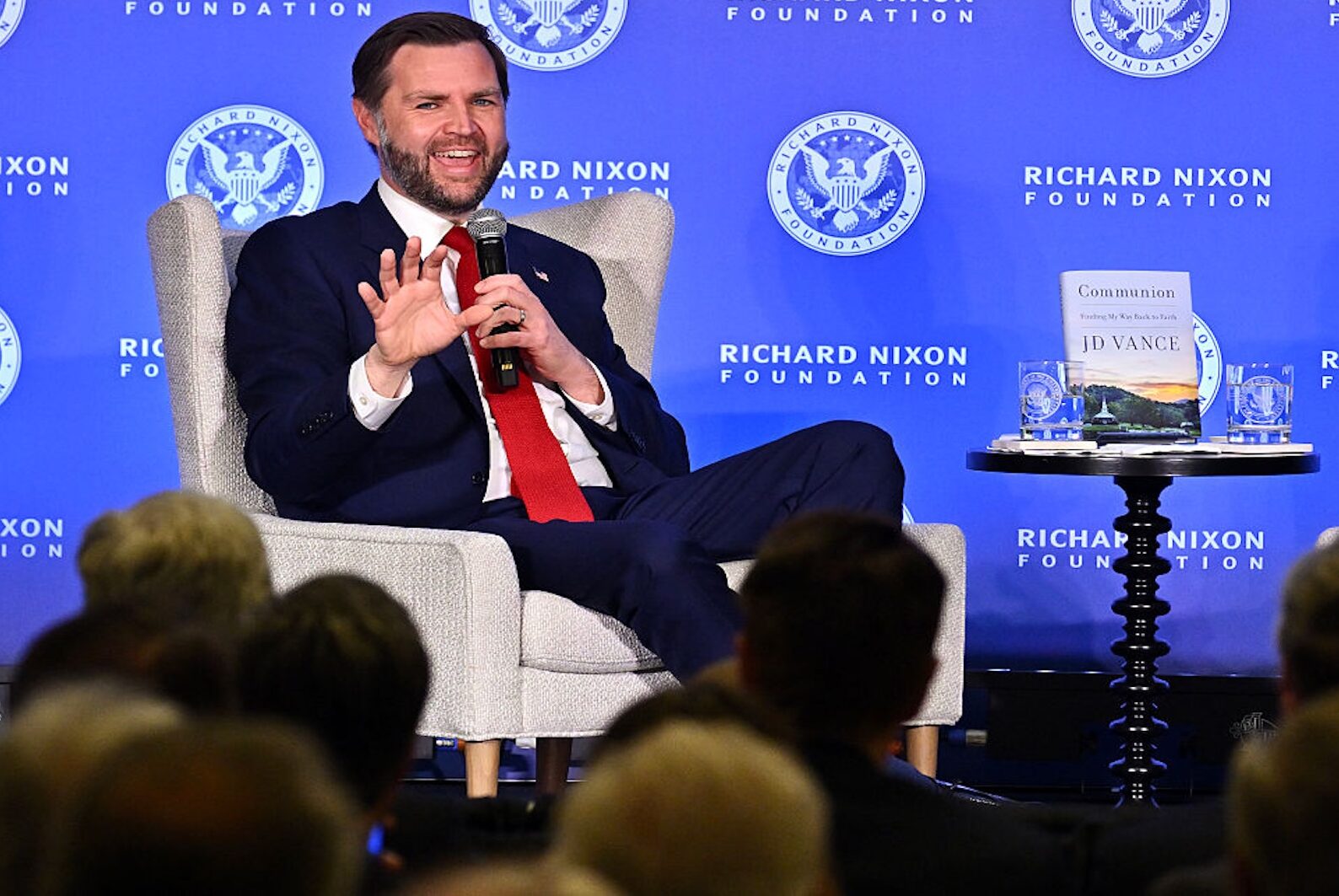
Donald Trump wants the November midterms to be a referendum on “communism.” His vice president has other ideas. JD Vance, on tour to promote his latest book, is keeping the focus on the failures of unfettered capitalism.
As Trump travels the country warning that newly ascendant democratic socialists — figures like New York’s Zohran Mamdani, Claire Valdez and Darializa Avila Chevalier — represent an existential threat to the United States, Vance has spent much of the summer making a remarkably different argument: that the Republican Party should embrace a more activist government capable of reshaping the economy in the interests of workers and families. When taken separately, neither message is surprising; both neatly highlight the core contradiction of the Republican Party in the Trump era.
On his book tour, Vance has built a case that should sound oddly familiar to anyone who has heard the Democratic Socialists of America’s talking points. He has told audiences that the country needs to “undo 40 years of failed economic policy” — a pointed reference, because four decades back means the Reagan era. Vance has argued that the Republican Party should abandon the deregulatory playbook of the late Milton Friedman, the intellectual godfather of Reagan-era supply-side economics whose ideas were, for decades, treated as holy scripture by the GOP establishment. They provided the moral and intellectual justification for cutting taxes on the rich, gutting the social safety net and dismantling corporate regulations.
“The economy is a tool to service the dignity of the human person,” Vance told the “Daily Wire” podcaster Michael Knowles. “If a set of economic policies make it easier for a person to raise a family, to earn a living wage, to give back to their community, to maybe go to church on Sunday or to actually spend some leisure time building the kind of life that matters, that is the sort of thing we want to be supportive of.”
Strip the God-talk and the Catholic social-teaching gloss off that last sentence and you have the premise that every democratic socialist candidate on the New York ballot ran on.
Strip the God-talk and the Catholic social-teaching gloss off that last sentence and you have the premise that every democratic socialist candidate on the New York ballot ran on: that markets exist to serve people, not the other way around, and that when they fail to do so, the state has not just a right but an obligation to intervene.
This is precisely the kind of argument Trump is trying to convince voters is dangerous by deploying the specter of communism, a tried-and-true tactic in GOP politics for nearly 100 years. Reacting to the slate of democratic socialists that swept congressional primaries in New York, Colorado and Pennsylvania, the president announced that “the communists are finally making their move.” A few days later, at the Faith & Freedom Coalition’s policy conference, he called DSA winners “animals” and falsely claimed that “assassinations of those who oppose them is a very important element of their ideology.” Democratic socialists, Trump has told crowds, are the single greatest threat the republic has faced in 250 years, and he has warned that these “godless communists” will target Christianity specifically.
Predictably, Vance’s leftward drift on economic rhetoric has triggered an absolute meltdown among the conservative establishment.
On Fox Business News, former Trump economic advisers Larry Kudlow and Steve Moore openly balked at Vance’s rhetoric. “I can’t imagine what JD Vance is getting at,” Kudlow stammered on air, visibly agitated as he desperately tried to assure his viewers “that these things are not consistent with the president.” Washington Examiner columnist David Harsaynai wrote that “It’s clear Vance doesn’t believe human flourishing and a free-market system are compatible. And those who assure me the vice president is merely focused on a grand Hamiltonian prioritizing of national defense and strategic industries — Trump’s justification for taking major stakes in private companies — probably haven’t read his new book ‘Communion.’” In the Wall Street Journal, Barton Swaim’s review of Vance’s book questioned whether the vice president’s ideological evolution reflects conviction or political convenience.
To be clear, Vance has built his entire post-”Hillbilly Elegy” political identity around this specific brand of economic populism, which accepts a vastly larger role for the federal government in regulating markets than any mainstream Republican would have dared suggest a decade ago. But he has recently taken to adding an escape hatch for himself with the idea of “woke capitalism” — a clever frame that allows him to rail against corporate power while insisting the real villain is progressive cultural influence laundered through boardrooms. This enables him to sound like a class warrior without ever having to disavow capitalism itself. But in noting that “the most likely inheritor of Trump’s throne is someone who is, if anything, considerably to the president’s left on economics,” the Hill’s Robbie Soave warned that Vance’s argument that “free markets are somehow antithetical to human dignity is explicitly progressive framing” makes the vice president sound like he’s competing with rising left-wing stars, such as Reps. Alexandria Ocasio-Cortez of New York or Ro Khanna of California, on their own turf rather than opposing them.
In perhaps the most troubling sign for the White House, Vance’s book tour drew severe public pushback from the Club for Growth, one of the most powerful and well-funded free-market advocacy groups in Republican politics. Rebuking the vice president’s comments, the organization’s president David McIntosh took to social media to aggressively defend the old guard, recently writing on X, “With all due respect, Mr. Vice President, you are dead wrong about both Milton Friedman and Alexander Hamilton. Both of them promoted free markets as the way to make America Great.”
This public spat represents a major structural fracture ahead of the midterms. Since its founding in 1999, the Club for Growth has been the primary enforcer of fiscal conservatism in Washington. Their super PAC plans to spend $175 million during this year’s midterm elections, and they have historical reasons to distrust Vance, having spent heavily to oppose his 2022 Senate primary run in favor of traditional conservative Josh Mandel.
This right-wing panic exposes the big weakness of Trump’s midterm strategy.
The president’s anti-“communist” message only works if voters accept a clean, binary choice: Democrats want to replace capitalism, Republicans want to defend it. If voters stop focusing on Trump’s apocalyptic vocabulary and start looking at the actual substance of the debate, they will find that a fair amount of the democratic socialist platform — implementing rent control, breaking corporate monopolies, supporting union power and rejecting the market as an infallible moral arbiter — sits far closer to Vance’s stated worldview than to Trump’s, whose corporate tax cuts were faithful to Reagan-era orthodoxy. Trump cannot effectively frame democratic socialism as a godless, civilization-destroying virus when his own vice president is crisscrossing the country arguing that the capitalist system we currently live under is actively destroying human dignity and the American family.
Our Summer sale is on!
Once the election is fought on those terms, the Republicans have already lost the macro-argument. By promoting the progressive notion that the free market has failed the American people and the state must step in to regulate capital for the common good, Vance has effectively validated the entire structural critique that democratic socialists have been making for years. He has surrendered the intellectual high ground of the conservative movement.
Trump’s desperate, screaming rhetoric about “godless communists” is nothing more than a smoke screen, a frantic attempt to hide the fact that even his own vice president no longer believes in the capitalist fairytale the Republican Party has been selling to America for half a century.